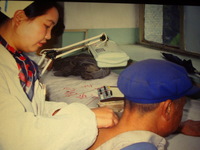
A seven year international and multi-disciplinary team, including European, American, Canadian and Australasian researchers, has found some complementary therapies such as acupuncture and massage, are better choices for managing most common neck pain, than many current medical practices.
The Bone and Joint Decade 2000-2010 Task Force on Neck Pain, was created to help health professionals and neck pain sufferers, use the best research evidence to prevent, diagnose and manage the condition. Neck pain is widespread, and can be associated with headaches, arm pain, upper back pain and depression. It may arise from injuries such as whiplash, occupational factors, or stress, and for most sufferers, it is persistent and recurrent.
(Spine Journal 2008 and CAM, March 2008.)
 A Swedish review article has evaluated the use of acupuncture for polycystic ovary syndrome (PCOS), specifically its prevention and reduction. Assessing clinical data from studies in women with PCOS, and rat models of PCOS, the authors suggest acupuncture may benefit PCOS patients by affecting the neuroendocrine system, and exerting long-lasting beneficial effects on the metabolic and endocrine (hormone) systems and on ovulation.