
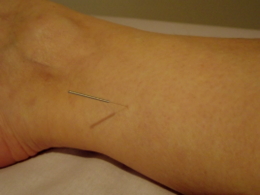
A report commissioned by the charity Arthritis Research UK, reveals acupuncture to be the most effective complementary medicine for treating musculoskeletal conditions, and one of only a few therapies the use of which is supported by medical evidence.
The report examined trial data on a range of twenty-five complementary therapies, and was aimed at helping patients and health professionals choose approaches which were both safe and effective. The therapies found to be most effective were: acupuncture for osteoarthritis, lower back pain and fibromyalgia; massage for lower back pain and fibromyalgia; tai chi for osteoarthritis; yoga for back pain. Dr Gareth Jones, from the University of Aberdeen, who was the main author of the report, points out that approximately one quarter of the UK population uses complementary therapies in one form or another; the use of these therapies is higher among people with pain or musculoskeletal conditions such as arthritis.
(Practitioner-based complementary and alternative therapies for the treatment of rheumatoid arthritis, osteoarthritis, fibromyalgia and low back pain. Published on-line 9 January 2013.)
