
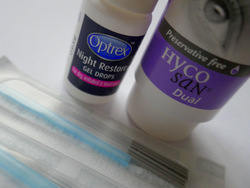
 A team of American researchers led by the Department of Ophthalmology at the University of Pittsburgh Medical Center, has shown acupuncture can be a helpful addition to routine clinical treatment of dry eye. A cohort of 49 patients were randomly assigned to receive either true (24) or (25) sham acupuncture. Treatment was given twice, on consecutive days. One week after treatment, both groups exhibited improvements on the ocular surface disease index, but at six months, the improvement was significantly greater in the true acupuncture group. By three months, true acupuncture was associated with improvements in many subjective measures of dry eye symptoms (eg scratchiness, redness & discomfort), although several objective measures remained unchanged. Even though not statistically significant, true acupuncture patients required fewer artificial tears.
The researchers conclude that acupuncture can be an effective adjunct to routine clinical treatment of dry eye, especially given its low risk profile.
(Acupuncture and dry eye: current perspectives. A double-blinded randomized controlled trial and review of the literature. Clinical Ophthalmology, 24 April 2019.)
