
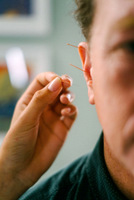
 American clinicians have found that a type of ear acupuncture termed battlefield acupuncture, reduces pain and opioid use in military veterans undergoing surgery. A total of 72 patients, mean age 64 and scheduled for major surgery under general anaesthesia, were randomly assigned to receive either ear acupuncture or sham acupuncture for postoperative pain. Surgery was typically abdominal, thoracic or for hip/knee replacements.
Median postoperative opioid consumption was significantly lower in the acupuncture group (18 units) compared to the sham group (39 units). Also lower in the acupuncture group, were subjective pain intensity, nausea and vomiting. Only one acupuncture group patient experienced nausea, compared with 13 in the sham group.
The researchers conclude that the diminished postoperative pain intensity, reduced postoperative opioid requirement, and the lower incidence of postoperative nausea and vomiting observed, demonstrate the potential advantages of this low-cost and low-risk therapy in this patient population. Further research is needed to test its effectiveness in individual surgical procedures.
(Battlefield Acupuncture Use for Perioperative Anesthesia in Veterans Affairs Surgical Patients: A Single-Center Randomized Controlled Trial. Journal of Integrative & Complementary Medicine, 10 August 2022.)
