
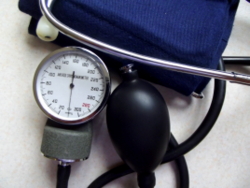
In the US, nearly a third of the population has high blood pressure. Now researchers in California have found that electroacupuncture (running very small electrical currents between needles inserted at acupuncture points) has a significant and long-lasting benefit in patients with chronic high blood pressure.
A total of 65 patients with mild to moderate hypertension (in excess of 140–180/90–99mmHg) and not taking medication, were randomly allocated to one of two groups. The first group were given electroacupuncture at a set of active acupuncture points. The second group were given the same treatment at a set of control points. Treatments comprised a thirty minute session once a week for eight weeks. Patients were monitored using a 24 hour ambulatory monitoring kit.
After eight weeks, 70% of patients in the active treatment group had achieved a significant decrease in peak and average systolic and diastolic blood pressure. These improvements, which persisted for six weeks after cessation of treatment, were underscored by blood tests showing reductions in noradrenalin and renin (which raise blood pressure). No corresponding changes were seen in the control group.
(Long-Lasting Reduction of Blood Pressure by Electroacupuncture in Patients with Hypertension: Randomized Controlled Trial. Medical Acupuncture, 18 August 2015.)
