
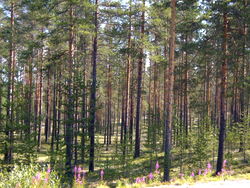
Researchers in Japan have shown how a brief walk in the woods can elicit both physiological and psychological relaxation responses in middle-aged individuals with high blood pressure. In a pilot study, twenty such participants were asked to walk set routes in forest and urban environments, the latter acting as a control. Route length, walking pace and energy expenditure were designed to be the same whichever environment was walked.
Heart rate was found to be significantly lower in the forest compared to the urban environment. Heart rate variability suggested a significantly higher relaxation response in the forest. A questionnaire used to assess participants’ qualitative responses showed that compared with the urban route, the forest route increased “comfortable”, “relaxed”, “natural” and “vigorous” sensations, and decreased the urge to report “tension-anxiety”, “depression”, “anxiety-hostility”, “fatigue” and “confusion”.
(Effect of forest walking on autonomic nervous system activity in middle-aged hypertensive individuals: a pilot study. Int Journal of Environmental Research & Public Health, March 2015.)
