
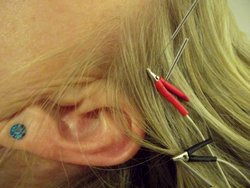
A study by hospital and university researchers in Londrina, Brazil has shown scalp electro-acupuncture can reduce tinnitus intensity by half, and improve quality of life for affected individuals. Fifty subjects, aged 50 to 85, were randomised to receive either acupuncture or no treatment. Those in the treatment group received electro-acupuncture on the vestibulocochlear scalp line, two times a week for five weeks. The results showed a reduction in tinnitus intensity of 50% in the treatment group, and no change in the control group. Acupuncture was also associated with a decrease in the influence of tinnitus on quality of life, from a classification of “severe interference” to “mild interference”. Again there was no change in the control group.
The team concludes that the significant levels of improvement justify the use of acupuncture. Their study shows that the technique is safe and does not cause any side effects for patients. However, more studies are required to establish other possible effects of Chinese scalp acupuncture on the auditory system.
(Effectiveness of acupuncture therapy as treatment for tinnitus: a randomized controlled trial. Brazilian Journal of Otorhinolaryngology, July-August 2016.)
