
Acupuncture administered to a well-known point on the ankle, can enhance activity in areas of the brain associated with memory, in patients suffering from mild cognitive impairment (MCI).
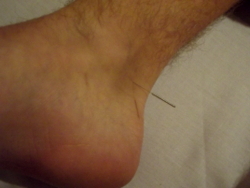
Researchers used functional MRI scans to measure brain activity in both MCI patients and healthy controls, whilst they were being needled either superficially or more deeply, at the acupuncture point Taixi (illustrated left). Compared with healthy controls, the MCI patients’ scans revealed abnormal functional connectivity in the temporal regions of the brain (hippocampus, thalamus, fusiform gyrus) which are implicated in memory and information retrieval. Following deep needling, there were significant and persistent enhancements in the functional connectivity of these regions compared with only superficial needling.
The researchers conclude that the enhanced connectivity in the memory-related brain regions following acupuncture, may be related to the purported therapeutically beneficial effects of acupuncture for the treatment of MCI. Further, the differences observed between deep and superficial needle insertion suggest that deeper muscle insertion is necessary to achieve an appreciable clinical effect.
(FMRI Connectivity Analysis of Acupuncture Effects on the Whole Brain Network in Mild Cognitive Impairment Patients. Magnetic Resonance Imaging, June 2012.)
