
Acupuncture as good as Drugs for Intervertebral Disc Pain

Acupuncture for radicular pain patterns.

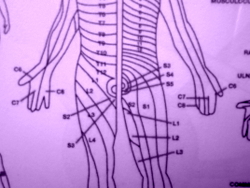
Researchers in Turkey have found that acupuncture is a promising treatment option for the management of radicular pain (pain radiating in recognised patterns through the body indicative of pressure on specific spinal nerves at intervertebral disc level). They concluded it is non-invasive and with minimal side-effects.

Eighty patients (43 women and 37 men) with acute radicular pain of either lumbar or cervical (neck) origin, were randomly assigned to receive either nonsteroidal anti-inflammatory drugs (NSAIDs), or acupuncture. Half the group had lumbar disc herniations and half had cervical disc herniations, all diagnosed by NMR or CT scan. The NSAID administered was Tenoxicam plus another drug to protect the stomach from possible side-effects of the NSAID.

The effects of acupuncture were similar to those of NSAIDs, although for the cervical group ie pain originating in the neck, acupuncture was significantly more effective than NSAIDs in the short term. The benefits of acupuncture were noticeable after four treatments in the neck pain cases and six treatments in the lumbar pain cases. All forty acupuncture patients completed the study, whereas eight of the NSAID patients dropped out, three due to gastric side-effects of the drug. Patients found acupuncture interesting, and some were unwilling to take medication long-term.

(Effectiveness of Acupuncture with NSAID Medication in the Management of Acute Discogenic Radicular Pain: A Randomised Controlled Trial. Journal of Anesthesia and Clinical Research, March 2012.)


Acupuncture for Lower Back Pain Saves on Healthcare Costs

Research from Canada: acupuncture for lower back pain

Researchers in Canada have found that patients receiving acupuncture for lower back pain, are less likely subsequently to re-visit their GP for the problem, thus saving on healthcare costs.

The study examined 201 cases in which lower back pain was treated with acupuncture, and compared these with 804 controls, all drawn from acupuncture clinic and physician’s patient records in Alberta. Comparing the one year period pre-acupuncture with the one year post-acupuncture, physician visits by patients in the acupuncture group, decreased by 49%, whereas in the comparison group, the equivalent figure was only 2%. This flowed through into healthcare cost reductions of 37% for the acupuncture group, and 1% for the comparison group.

(Reduced Health Resource Use after Acupuncture for Low-Back Pain. Journal of Alternative & Complementary Medicine, Nov 2011.)

Acupuncture for Chronic Lower Back Pain

A pilot study looking at two different frequencies of treatment by acupuncture for chronic lower back pain, has found that improvements achieved within the first two weeks, were still present at one year follow-up.

Thirty participants with chronic lower back pain were randomly allocated to two groups to receive ten acupuncture treatments: the low frequency group received two treatments per week for five weeks, whilst the high frequency group received five treatments per week for two weeks. No significant differences were found between the groups in terms of measured outcomes, but clinically important improvements in pain, disability and quality of life, were achieved in both groups within the first fortnight, and were maintained at follow-up one year later.

(Different Frequencies of Acupuncture Treatment for Chronic Low Back Pain: An Assessor-Blinded Pilot Randomised Controlled Trial. Complementary Therapies in Medicine, June 2009.)

Acupuncture for Lower Back Pain

Research from Japan: lower back pain. Researchers in Japan have found acupuncture to be superior to the injection of local anaesthetic for the treatment of lower back pain. Twenty-six patients were randomly allocated to receive either acupuncture or local anaesthetic injection at two to five of the most painful points on the lower back, once per week for four weeks. Both groups experienced pain relief, but acupuncture provided significantly more pain relief at all time points measured, including at two and four weeks after completion of treatment.

The authors of the study conclude that both injection and acupuncture relieved pain, but acupuncture was superior for the immediate and sustained effects, suggesting that it is a useful treatment for lower back pain. The difference in the effects may be attributable to differences in the mechanism of pain suppression.

(Comparison of the Effectiveness of Acupuncture Treatment and Local Anaesthetic Injection for Low Back Pain: A Randomised Controlled Clinical Trial. Acupunct Med Dec 2009.)

Acupuncture for Lower Back Pain

Research from Japan: acupuncture for lower back pain Japanese university researchers have examined the effects of acupuncture for lower back pain, and related mood disturbances and medical expenses, among employees of a steel firm.

Acupuncture was given once a week to 72 workers, averaging 53 years in age. After eight weeks of treatment, patients reported less pain and a significant decrease in mood disturbance. There were also significant reductions in the number of visits to hospital for conventional care, and in medical expenses related to lower back pain. The authors say we can expect wide-ranging economic effects if acupuncture treatment were to be introduced into companies.

(Acupuncture Can Reduce Perceived Pain, Mood Disturbances and Medical Expenses Related to Low Back Pain among Factory Workers. Industrial Health, 2008).